Moldova’s Challenges and Priorities in Justice, Social and Economic Areas Following the European Commission’s Recommendation to Open EU Accession Negotiations, Discussed with Media Representatives
Automatically translated summary. The full article is available in Romanian.
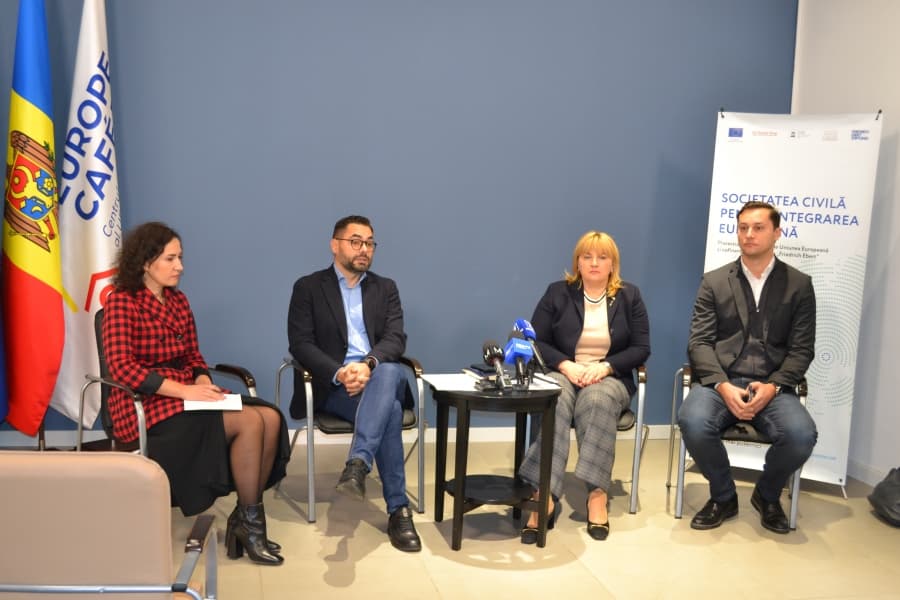
On 13 November, the Independent Think Tank “Expert-Grup”, together with IPRE, the Institutum Virtutes Civilis and the Friedrich Ebert Foundation Moldova, held a press club with journalists on the next steps and reform priorities in justice, the economy and social policy after the European Commission recommended opening EU accession negotiations with Moldova.
Iulian Groza of IPRE said Moldova is receiving good signals and will be assessed on merit. In justice, the Commission highlights two critical indicators: vetting of future Supreme Court judges, with concrete progress expected by March, and the nomination of the prosecutor general.
Adrian Lupușor of Expert-Grup named fiscal consolidation, competitiveness, the business climate, state-owned enterprise reform, statistics and next year’s census as economic priorities. On the positive side, talks begin after eight years of the DCFTA, full trade liberalisation would affect about 1–2% of budget revenue, and the EU accounts for over 80% of the FDI stock. Liliana Palihovici of IVC outlined social priorities: dialogue between government and opposition, legislative transparency, local administration and public-sector pay reform, gender equality, violence prevention and children’s rights. She noted that Moldova invested about 0.2% of GDP in research, against 2.3% in the EU.
Other articles in the same category
See all
Ceadîr-Lunga Launches Its Third Municipal Bond Issue, Raising MDL 8 Million for Local Projects

24 Municipalities from the Republic of Moldova Complete a Study Visit to the Kingdom of the Netherlands

Winners of Tulip Business Incubator 3.0 Announced: Five Businesses to Receive EUR 5,000 Grants and Mentoring