
Round table “Transparency and economic efficiency of the use of Ecological Funds in the Republic of Moldova”
On 19 July 2011 the Independent Think Tank organised a round table at which the study “Investigating the transparency and economic efficiency of the use of Ecological Funds in the Republic of Moldova” was presented. The study was prepared with the financial support of the Soros Foundation Moldova. This press release includes the most important conclusions and recommendations of the study.
Ecological funds are instruments that make it possible to accumulate and channel the financial resources needed to solve environmental problems. In the Republic of Moldova the system of Ecological Funds is organised on two levels: the National Ecological Fund and the Local Ecological Funds. Owing to economic growth and the broadening of the tax base, over recent years the total volume of state budget expenditure on the environment has increased several times over, with the National Ecological Fund being the main source of financing. The Local Ecological Funds account for a more modest share, which reveals the limited capacity of local authorities to promote environmental policies. Although the regulatory framework has undergone several changes over time, it is not coherent and precise enough to ensure the successful operation of the Ecological Funds.
The Ecological Funds are managed by Administration Boards. The main executive functions within the Ecological Funds are performed by the Records and Control Service in the case of the National Ecological Fund and by the Secretaries of the Local Ecological Funds, as well as by other structures within the Ministry of the Environment, the State Ecological Inspectorate and the Ministry of Finance. The current forms of organisation and administration of the National Ecological Fund and the Local Ecological Funds do not correspond to good practice as regards the delimitation of the responsibilities of supervisory bodies from those of executive ones, the organisation and distribution of control and reporting functions, and compliance with the regulatory hierarchy. Likewise, the Local Ecological Funds, in their great majority, cannot be regarded as Ecological Funds in the sense in which they are described by the St Petersburg Guidelines (OECD, 1995), primarily because of their very small size.
The revenues of the Ecological Funds, especially of the National Ecological Fund, have grown exponentially in recent years, the essential contribution coming from the introduction in 2008 of a charge on plastic and / or “tetra-pack” packaging. The greatest concerns about the evolution of the revenue structure of the Local Ecological Funds relate to the growing volume of remaining balances, which reveals a number of shortcomings in planning and in the efficient use of resources. Other major shortcomings in the formation of the revenues of the Ecological Funds relate to the lack of effective communication and cooperation between the Ministry of the Environment and the Customs Service, the lack of a single mechanism for controlling payments into the National Fund and the Ecological Funds and of a single database of polluters, discrepancies between data on the tax base, the lack of fairness in payments into the National Fund and the Local Funds, and the limited administrative capacity of the Local Ecological Agencies / Inspectorates.
The project cycle within the National Ecological Fund consists of several stages in which: potential beneficiaries are informed about the opportunities offered; the files with the documentation submitted by the beneficiary are analysed; the projects that will receive funding are selected; and the interim and final results achieved by the beneficiary are monitored. At present, performing these functions is complicated by inconsistent legislation, the limited capacity to supervise projects and the lack of operational plans that would set short-term spending priorities. At the level of the Local Ecological Funds, the most important shortcoming identified in the study is the lack of a stage for informing potential beneficiaries.
The main instruments for ensuring transparency are the section on the National Ecological Fund on the website of the Ministry of the Environment and the structure of the Administration Boards, which include a representative of environmental organisations. However, the Ecological Funds have no transparency policies of their own, and transparency measures are seen as a formal requirement imposed by the general legal framework. For this reason, the level of transparency and participation is not sufficient to ensure an effective and efficient use of resources.
Given that the problems arising from the regulation of the Ecological Funds are systemic in nature, they can be eliminated only through an integrated approach. To this end, it is first of all necessary to develop a clear concept of the system of Ecological Funds in the Republic of Moldova. The concept must strike a balance between the political, technical, financial and legal aspects existing at present, a balance that would ensure the effective operation of the Funds in implementing environmental policies. Experts and persons holding relevant political positions must be involved in developing the Concept, so that the outcome is politically and financially sustainable and ensures maximum efficiency and transparency in the future activity of the Ecological Funds.
Related events
See all
Closing Event of the Project “Support for Labour Market Reform”
29 October 2026, at 09:00
Digital Park, Innovation Hall

Launch Event: Local Development through the Capital Market. Launch of Public Offerings of Municipal Bonds Issued by Ungheni Municipality and Leova Town
10 August 2026, at 11:00
Summit Events
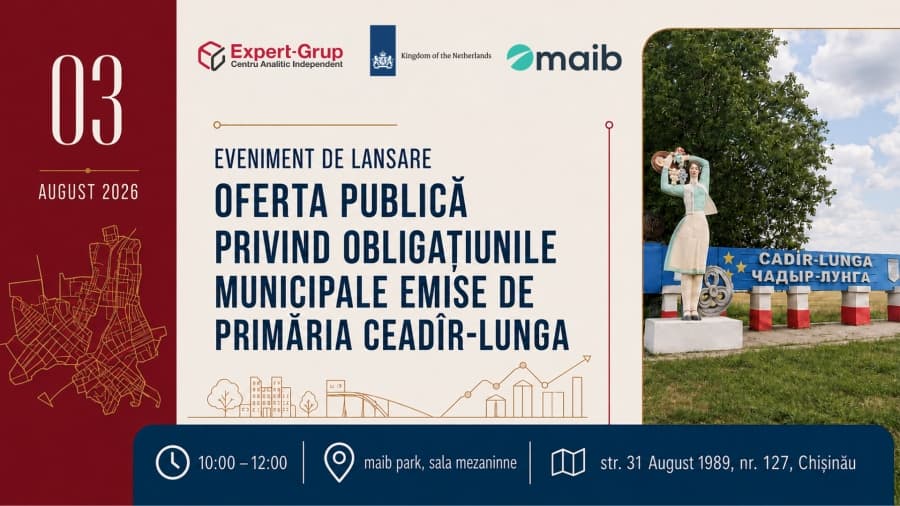
Launch Event: Public Offering of Municipal Bonds Issued by the Ceadîr-Lunga City Hall
29 July 2026
maib park, Mezaninne Auditorium
National Forum on the Labour Market and Social Dialogue of the Republic of Moldova
30 April 2026, at 09:00
Digital Park, Community Hall